
Children and teenagers are naturally curious and during moments of crisis, emotional pain or impulsivity, access to an unsecure firearm or medication can turn a difficult moment into a tradgedy. Research shows that nearly all youth suicides involving a gun are carried out with a weapon from their own home or a telative’s. The same is true for medication: a single undervised dose of many common prescriptions can be life threatening to a child. Locking up guns and securing medications are two of the most powerful things a parent can do within their home–not because you don’t trust your child, but because you love them enough to remove the risk entirely. In a moment of crisis, a lock buys time. And time saves lives.
Please reach out to Huskies Together or your school’s counselor within the City of Trussville for a FREE home safety kit. Each kit includes a gun lock and medication lock bag with supportive services in our community.
In partnership with Hewitt Trussville City Schools, Huskies Together offers this resource guide to the prevention of youth suicide. This page is intended as a starting point for those young people struggling with suicidal feelings, their families, and their friends.
Struggling Yourself?
If you are here because you are struggling with suicidal feelings, we urge you to reach out to the trusted adults in your life. Know that you can get help. Please fight any feelings you have that there is no help and no hope. One of the most common causes of suicidal feelings is clinical depression. Depression alters your thinking and convince you that there is no hope, that your friends and families will be better off without you, that the pain you are experiencing can never get better. Those thoughts are symptoms of depression–a true illness that ANYONE can get.
Know that the vast majority of people who struggle with suicidal feelings, do not die by suicide. They live on to learn that there is hope. In turn, awareness of hope allows many to survive the hardest of times.
The stigma facing those who have depression, mental illness, and suicidal feelings may not be entirely gone, but it has been greatly reduced. So we strongly encourage young people who struggle in these areas to reach out to those who can help.
In addition to reaching out to trusted adults, there are resources listed below where you can seek support and help.
Concerned About A Young Person?
If you are here because someone you know is struggling with suicidal feelings, please do not keep silent. Sometimes we make promises to keep secret things that are said to us and then realize that secrecy may prevent someone from getting help. If you have made a promise to keep secret a friend’s struggle with suicidal feelings, please put that aside. Insist that your friend talk to his or her parents, school counselor, doctor, youth minister, or some trusted adult. If he or she won’t reach out, please reach out yourself. Immediately seek advice from your parents, from your school counselor, or speak to one of the resource agencies or persons below.
IN AN EMERGENCY: CALL 911 or 988.
Youth Suicide Warning Signs
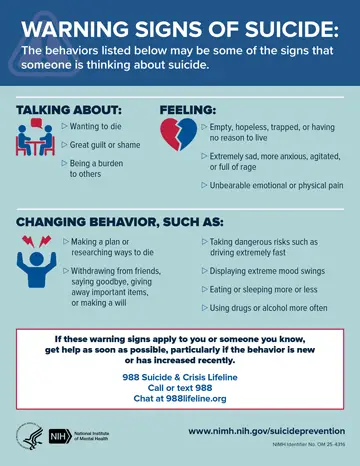
If you know someone who has any of the warning signs, these are things that you can do to help:
Ask them if they are okay and listen to them like a true friend.
Tell them you are worried and concerned about them and that they are not alone.
Talk to an adult you trust about your concerns.
If you are the parent of someone who has warning signs:
Ask if they are having thoughts of suicide
Do all you can to prevent access to methods of suicide, particularly guns and medications. Firearms should be removed from premises or securely locked away (see Huskies Together for home safety kit).
Express your concerns about you are observing in their behavior
Listen attentively and non-judgmentally
Reflect on what they share and let them know they have been heard
Tell them they are not alone
Let them know there are treatment options that can help
Guide them to professional help through your pediatrician, guidance counselor or Children’s of Alabama Psychiatric Intake Response Center (PIRC)
Get Help
- Suicide Prevention Information – From the National Suicide Prevention Lifeline
- Save a Friend: Tips for Teens to Prevent Suicide (Natl Assoc. School Psychologists)
For Emergencies Related To Suicide Danger
- Call 911 or 998
- Go the nearest hospital emergency department. UAB and Children’s of Alabama are among the emergency departments that are staffed to deal with suicidal emergencies at all times.
Crisis Center (Birmingham)
- CRISIS LINE: (205) 323-7777. Information on the web: www.crisiscenterbham.org
- UTALK FOR TEENS: Call or Text (205) 328-5465. Text counseling is available from 3:00 pm – 10:00 pm every single day.
More information on the web:
https://www.crisiscenterbham.org/utalk/
National Suicide Prevention Hotline
- 1-800-273-8255 or 988
For Mental Health Care
- If you or your friend/family member is not in immediate danger, seek out mental health evaluation and care.
- Start with your pediatrician or physician. Your doctor will be able to assist in getting an appointment with a psychologist, psychiatrist, or other licensed mental health professional.
Children’s Of Alabama Psychiatric Intake Response Center
Phone triage services are provided to anyone with a youth-oriented mental health concern. Staff assesses the mental health needs of the child or teen based on the adult caller’s description or in-person intake assessment and determines the appropriate level of care needed.
8:00 am – 11:00 pm
Call 205-638-7472 (PIRC)
Common Sense Media
- Common Sense Media is an incredible resource for parents to find tons of articles on parenting, media, and so much more!